


We Compare 100's of loans from leading lenders


Need to borrow against your property but already have a mortgage, an existing secured loan or a mortgage lender that won’t consent to further borrowing?There may still be options available.
At Willows Finance, we work with specialist lenders that can consider equitable charge loans, third charge secured loans and micro-mortgages for mortgage-free properties.
These arrangements can allow homeowners to access additional funds without necessarily replacing an existing mortgage. However, the options available depend on the property’s equity, existing borrowing, lender criteria and legal requirements.
Below, we explain how different property charges work and when specialist lending may be an option.
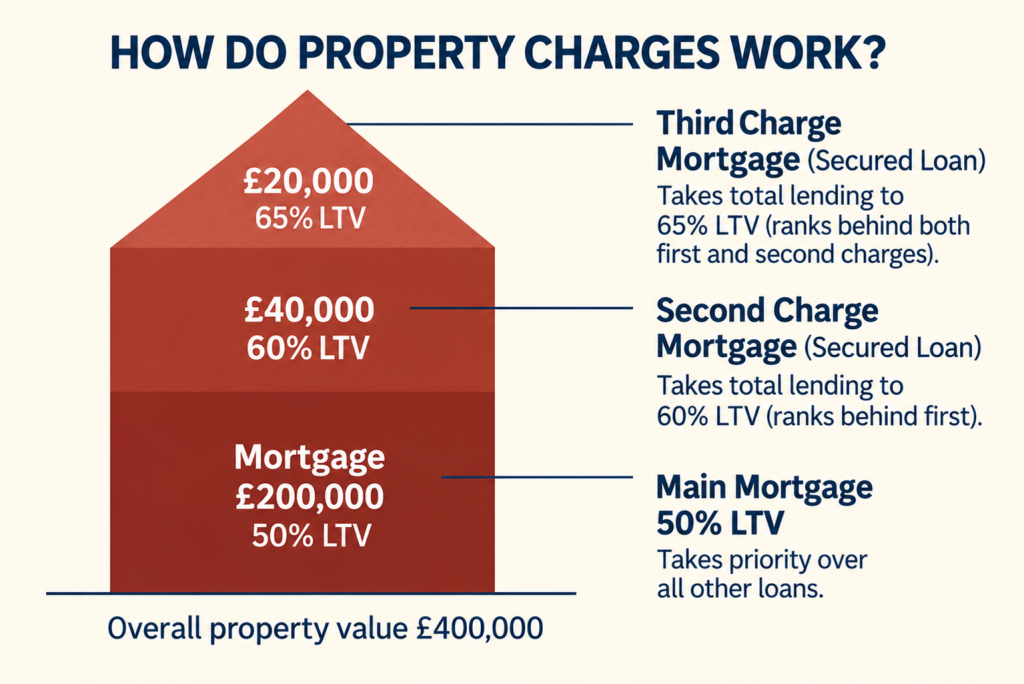
When you take out a mortgage or secured loan, the lender will usually take a legal charge over the property.
A charge gives the lender security for the money borrowed. The ranking of charges generally determines the order in which secured lenders are repaid if the property is sold and the debts become payable.
A first charge is usually the mortgage used to purchase or remortgage a property.
The first charge lender normally has priority over lenders holding second or third charges.
A second charge secured loan allows you to borrow against the equity in your property while keeping your existing first-charge mortgage in place.
For example, you might have a mortgage with one lender and take out a separate secured loan with another. The second charge lender ranks behind the first charge lender.
This can be useful if you want to raise additional funds without replacing an existing mortgage that has favourable terms or early repayment charges.
A third charge secured loan is an additional loan secured against a property that already has a first and second charge.
The third charge lender generally ranks behind both existing secured lenders. Because the lender has a lower repayment priority, third charge lending can involve additional restrictions, higher borrowing costs or a more detailed assessment.
The number of charges on your property doesn’t, by itself, determine whether you can borrow more. The lender will also consider your available equity, affordability and existing commitments.
In This Guide
Other Categories
Potentially. Some specialist lenders may consider an equitable charge loan where a conventional second legal charge isn’t possible or the existing mortgage lender has declined consent.
When arranging a standard second charge, it may be necessary to obtain consent from the first-charge mortgage lender.
Many mortgage lenders are prepared to consider these requests, but some may refuse consent or apply restrictions.
Where this happens, an equitable charge may be an alternative, depending on the circumstances.
An equitable charge is a form of security that gives the lender an interest in the property without necessarily being registered in the same way as a conventional legal charge.
However, an equitable charge doesn’t automatically remove the need for consent or override restrictions in your existing mortgage agreement.
The proposed lender and its legal representatives will need to establish whether the arrangement is acceptable, including any relevant mortgage conditions, title restrictions and legal requirements.
Not all secured loan lenders offer equitable charge arrangements, so the options may be more limited than for a conventional second charge.
If your mortgage lender has refused consent, or you know it doesn’t normally allow additional charges, our advisers can check whether an equitable charge lender may be able to consider your circumstances.
An equitable charge is an alternative way of securing a loan against your property, which can be useful if your existing mortgage lender refuses permission for a standard secured loan.
For example, you may want to borrow £30,000 against your home, but your mortgage provider won’t consent to a second charge. Rather than having to remortgage or give up on the application, some specialist lenders may be able to offer a loan using an equitable charge instead.
This can allow the loan to proceed without obtaining the usual consent from your mortgage provider, provided the arrangement is legally permitted and meets the new lender’s requirements.
However, equitable charges carry additional risks for lenders because their rights over the property can be more complicated to enforce if repayments aren’t maintained.
Because of this increased risk, equitable charge lenders usually have stricter lending criteria, which can limit how much you can borrow and which applicants they can accept.
They will consider factors such as your property’s value, available equity, existing mortgage, credit history and ability to afford the repayments.
At Willows Finance, we work with specialist lenders that offer equitable charge loans. If your mortgage provider has refused consent, we can check whether an equitable charge could provide another option without changing your existing mortgage.
Yes. If you own your property outright and have no mortgage or other charge secured against it, you may be able to borrow using a micro-mortgage or another suitable first-charge product.
A conventional second charge secured loan requires an existing first charge. Where a property is unencumbered, meaning it has no existing mortgage or other registered secured borrowing, a new lender would generally take a first charge instead.
Some lenders on our secured loan panel offer smaller first-charge mortgages, commonly referred to as micro-mortgages. These can provide an alternative for homeowners who want to raise a relatively modest amount without arranging a larger conventional mortgage.Depending on the lender, a micro-mortgage application may follow a process similar to a secured loan application.
Some specialist lenders may also offer a more streamlined process than certain conventional mortgage products, although completion times will depend on the circumstances.
If your home is mortgage-free, our advisers can check whether a micro-mortgage or another first-charge option may be suitable.
The main difference is whether there is already a mortgage or other first charge on the property.
| Micro-mortgage | Second charge secured loan | |
|---|---|---|
| Typical property position | Mortgage-free | Existing first-charge mortgage |
| Security ranking | Usually first charge | Usually second charge |
| Main purpose | Raise funds against an unencumbered property | Raise additional funds while retaining an existing mortgage |
| Lender assessment | Affordability, property and credit criteria | Affordability, property, credit and existing mortgage criteria |
The term micro-mortgage describes a smaller mortgage product rather than a separate legal category of property charge.
The available loan amounts, terms and costs depend on the lender.

Yes. We work with lenders that can consider third charge secured loans where a property already has a first-charge mortgage and a second-charge loan.
For example, you may have:
A first-charge residential mortgage
A second-charge secured loan taken out for home improvements
A new requirement to raise additional funds
Rather than replacing your existing borrowing, a third charge lender may be able to consider a further loan secured against the property.
The lender will want to establish that there is enough available equity after taking account of the existing secured debts.
You’ll also need to meet its affordability, credit and property requirements.
Because a third charge lender ranks behind the existing secured lenders, the application may involve more restrictive lending criteria or higher costs.
If you already have two secured loans against your property, our advisers can review the outstanding balances and help establish whether a third charge may be available.
The amount of equity required depends on the lender’s maximum loan-to-value (LTV) criteria and the borrowing already secured against the property.
Lenders will generally consider the combined amount of secured borrowing, rather than looking only at the proposed new loan.
For example:
| Property and borrowing | Amount |
|---|---|
| Property value | £300,000 |
| First-charge mortgage | £150,000 |
| Existing second-charge loan | £30,000 |
| Proposed third-charge loan | £20,000 |
| Total secured borrowing | £200,000 |
| Combined LTV | 66.7% |
In this illustration, the total secured borrowing would represent approximately 66.7% of the property’s value.
This doesn’t mean that a lender will necessarily approve the loan. The maximum LTV available for third charge borrowing varies, and the lender must also be satisfied with affordability and its other criteria.
If you know your property’s approximate value and the outstanding balances on your existing loans, we can help establish whether sufficient equity may be available.
A third charge can offer an additional borrowing option where a homeowner already has two charges against their property.
Potential benefits include:
Keeping existing borrowing in place: You may not need to replace your first mortgage or second-charge loan.
Accessing further equity: You may be able to raise funds for an acceptable purpose, subject to lender criteria.
Avoiding some refinancing costs: Retaining existing loans may avoid certain early repayment charges that could arise if you replaced them.
A separate repayment arrangement: The third charge will usually have its own terms and monthly repayment.
A third charge isn’t automatically preferable to remortgaging or refinancing. The overall costs and repayment commitments need to be compared.
Taking out a third charge means adding another debt secured against your property.
The main risks and considerations include:
Repossession risk: Your home may be repossessed if you don’t maintain repayments on borrowing secured against it.
Higher borrowing costs: Third charge loans may carry higher interest rates or fees because of the lender’s lower security ranking.
Reduced available equity: Additional borrowing leaves less equity in your property.
More monthly commitments: You’ll need to afford repayments on your existing mortgage, second charge and new loan.
Potential complications when selling or refinancing: Existing charges will need to be dealt with appropriately, and settlement costs may apply.
Before proceeding, it’s important to consider whether another borrowing arrangement could be more suitable.
Our advisers can help you understand the options available based on your existing loans and financial circumstances.
No.
One reason borrowers consider additional secured lending is to retain an existing mortgage rather than replacing it.
For example, you may have a competitive mortgage rate or face early repayment charges if you remortgage.
An equitable charge or third charge may provide an alternative in some circumstances, subject to lender criteria and legal requirements.
However, it’s worth comparing the overall cost of the available options, including interest, fees and monthly repayments. If you’re considering borrowing but want to keep your existing mortgage, tell us what charges are already registered against the property and whether your mortgage lender has imposed any restrictions.
We can then help establish which lending arrangements may be available.
Getting a quote won’t affect your credit score
We’re extremely proud to be rated ‘Excellent’ for our service standards. We’ve helped thousands of customers across the UK over the last 15 years to find the right finance for their needs – no matter how complicated the circumstances. And we look forward to helping you.
The documents required will depend on whether you’re applying for an equitable charge, third charge or micro-mortgage.
You may need to provide:
Your property’s estimated value
Details of existing mortgages and secured loans
Current outstanding balances
Information about your mortgage lender and any consent restrictions
Evidence of income and expenditure
Details of existing credit commitments
Information about the intended use of the funds
Relevant property title or legal documentation, where required
For a third charge application, accurate balances for both existing secured loans are particularly important.
For an equitable charge application, the lender may also need to review your existing mortgage conditions and any relevant title restrictions.
For a mortgage-free property, we’ll need to establish that the property is unencumbered and suitable for the proposed first-charge borrowing.
Whether your mortgage lender has refused consent to a second charge, you already have two secured loans or you own your property outright, the right borrowing option will depend on your circumstances.
At Willows Finance, we work with specialist lenders that can consider arrangements outside the standard second-charge application.
Our advisers can review the charges already secured against your property, available equity and any lender consent restrictions before identifying suitable options.
Request a free quote or call 01656 766 158 to discuss your property and existing borrowing with one of our experienced advisers.
Getting an initial quote won’t affect your credit score.
Your home may be repossessed if you do not keep up repayments on a mortgage or other loan secured against it.
If you have a question – we’d be happy to talk to you – simply call us…
(Mon-Fri 9am-8pm, Sat 10am-1pm)
Our Rating
At Willows Finance we ensure your personal information is kept secure and confidential.
PRIVACY OF YOUR INFORMATION
At Willows Finance Ltd, we appreciate that your privacy is extremely important to you. With this in mind, we have put in place a number of measures to ensure that any personal details we obtain from you as a result of visiting this website is processed and maintained in accordance with accepted principles of good information handling and also in accordance with the Data Protection Act 1988.
This statement provides you with details of the type of information we may hold about you, how we obtain and use information and how we protect your privacy.
Willows Finance Limited
Brocastle, Bridgend, CF35 5AS
Authorised and regulated by the Financial Conduct Authority
Firm Reference Number: 670052
Company Number: 06678545 (Registered in England and Wales)
This document explains the services we provide, the range of lenders and products we consider, how mortgage advice may be provided, and how Willows Finance may be paid. Please read it carefully before proceeding with an application.
If you need clarification about any part of this document, please contact us on 01656 766158.
Willows Finance arranges first and second charge mortgage products. Depending on the circumstances of the application, these may include:
We also arrange both regulated and unregulated bridging finance.
Not every product will be suitable or available to every customer. The products considered will depend on your circumstances, borrowing requirements, purpose of the borrowing, property, intended use of the property and the relevant lender criteria.
Depending on your circumstances, Willows Finance may:
If you are looking to increase borrowing secured on a property which already has a regulated mortgage, there may be different ways of raising the additional funds. Depending on your circumstances, these may include:
Where applicable, we will make you aware of these alternatives before proceeding. The options we are able to assess or advise on will depend on the service being provided and the lenders available to us.
The regulatory status of a mortgage or bridging loan depends on the circumstances of the transaction, including the property, how it is or will be occupied, the purpose of the borrowing and the customer’s circumstances.
Our business includes:
We will identify the regulatory status applicable to your application and explain the service and protections that apply. The protections available to you can differ depending on the type of mortgage or loan.
The range of lenders and products we consider depends on the type of finance you require.
We offer a comprehensive range of second charge mortgages from across the relevant market using a representative panel of lenders. We review our panel regularly to ensure that it remains sufficiently broad and representative. We do not consider products that are only available by applying directly to a lender.
We only offer first charge mortgages from a limited panel of 13 lenders. We consider the first charge mortgage products made available to us by Kensington Mortgages, The Mortgage Works, Aldermore, United Trust Bank (UTB), Together, Masthaven, West One, Norton, Bluestone, Vida, Pepper Money, Mansfield Building Society and Nationwide Building Society.
We do not offer every first charge mortgage available from across the market.
We consider products from a range of lenders available to Willows Finance for the relevant transaction.
Consumer Buy-to-Let and unregulated Buy-to-Let applications are considered within the relevant first charge, second charge or bridging route, depending on the structure of the transaction.
We do not provide a whole-of-market service and do not claim to consider every mortgage or secured finance product available in the UK. Our assessment is based on the lenders and products available through our lender and distribution arrangements.
Where the applicable regulatory rules require us to identify the lenders whose products we offer, the relevant lender list will be provided to you in a durable medium as part of the initial disclosure for your application. A lender list is also available on request where applicable.
The service provided will depend on the lender, product and application route identified for your circumstances.
Where Willows Finance provides the mortgage advice, we provide an advised mortgage broking service. We will obtain information about your needs and circumstances, assess the lending options available within the scope of our service and, where appropriate, make a mortgage recommendation.
We will make it clear where Willows Finance provides the mortgage advice and recommendation.
We may also provide a packaging service. This is a non-advised administrative service under which we may collect information and supporting documents, complete administrative checks, liaise with the relevant parties and submit or progress an application.
When we provide a packaging service, we do not assess the suitability of the mortgage, provide mortgage advice or make a personal recommendation. Any regulated mortgage advice or recommendation will be provided by the appropriately authorised intermediary responsible for advising you.
Our packaging service is not a regulated advisory service. However, the mortgage itself and any arranging activity connected with it may still be regulated and subject to the applicable regulatory requirements. We will explain the nature and regulatory status of the service we are providing before you proceed.
For some applications, particularly certain second charge mortgage applications, our sourcing exercise may identify a route where the subsequent mortgage advice is provided by another regulated mortgage intermediary.
In these cases, the Willows Finance service may include:
After the introduction, the receiving intermediary may take over the detailed application, advice and recommendation process. We will make it clear where this type of referral arrangement applies.
Where our sourcing process identifies Evolution Money Limited as an appropriate route and we introduce your application to Evolution Money, Willows Finance will not provide the regulated mortgage advice or make the final mortgage recommendation in relation to the Evolution mortgage.
Following the introduction, Evolution Money Limited will take over the detailed application and advisory process. Evolution Money will assess your needs and circumstances and will be responsible for any regulated mortgage advice and recommendation it provides in relation to the Evolution mortgage.
Willows Finance remains responsible for the service it provides before and in connection with the referral, including its initial assessment, sourcing and introduction activity.
If you are experiencing financial difficulty, or if you are considering borrowing to consolidate existing debts, free and impartial debt advice is available from MoneyHelper and other free debt-advice organisation.
MoneyHelper: www.moneyhelper.org.uk
You should consider obtaining free debt advice if you are unsure whether further borrowing or debt consolidation is right for you.
We process your personal information in accordance with our Privacy Policy. Where we introduce you to a lender or another intermediary, that organisation will process your information in accordance with its own privacy information.
Willows Finance Privacy Policy: willowsfinance.co.uk/privacy-cookie-policy/
The way Willows Finance is paid depends on the lender, product and application route. We may receive a fee paid by you, commission paid by a lender or another third party, or a combination of these. We will explain the basis on which we will be remunerated in connection with your application.
Where Willows Finance off an advised service our fees are split into two parts. A fee for the advice you receive and a fee for the processing of the application to completion. Both of these fees can be added to the loan rather than paid upfront or you have the option of paying them in advance. We do not arrange loans below £10,000.
For the advice the fee is as follows;
For a first charge mortgage, our advice fee is 5% of the amount borrowed, subject to a minimum fee of £625 and a maximum fee of £1,250.
For a second charge mortgage, our advice fee is 5% of the amount borrowed, subject to a minimum fee of £625 and a maximum fee of £1,750.
For a first charge mortgage, our processing fee is 5% of the amount borrowed, subject to a minimum fee of £625 and a maximum fee of £1,250.
For a second charge mortgage, our processing fee is 5% of the amount borrowed, subject to a minimum fee of £625 and a maximum fee of £1,750.
| Service | First charge | Second charge |
|---|---|---|
| Advice fee | 5%, min £625, max £1,250 | 5%, min £625, max £1,750 |
| Processing fee | 5%, min £625, max £1,250 | 5%, min £625, max £1,750 |
On borrowing of £10,000 5% would be £500, but the minimum fee for advice and processing means that we would charge £625 for each to £1250 in total.
On borrowing £20,000 the total fees would be £2,000
On borrowing £50,000 the maximum fee means that we would charge a total of £2500 for a 1st charge mortgage and £3500 for a 2nd charge mortgage.
If your mortgage or loan completes following an introduction made by Willows Finance, we will receive commission from the lender or another third party in the distribution chain unless we tell you otherwise. Different lenders may pay different amounts and may use different commission models.
Commission models may include:
The availability or amount of commission does not determine which lender we consider appropriate for your circumstances. Where applicable, we will tell you that commission will be received.
For an MCD regulated mortgage (a mortgage within the Mortgage Credit Directive rules), where the exact amount of commission is not known at the time of the initial disclosure, we will tell you that the actual amount will be disclosed later in the ESIS. Where applicable and on request, we will also provide information about how commission levels vary between lenders offering the mortgage being considered.
Where we introduce you to Evolution Money, the commercial arrangement is different from a broker fee charged directly by Willows Finance.
Under the current Evolution arrangement, Evolution Lending charges a Product Fee equal to 10% of the net loan advance, subject to a maximum of £5,000. If the mortgage completes, Evolution pays the corresponding amount to Willows Finance as commission/remuneration for the sourcing, distribution and introduction service.
The amount of the product fee and the amount of remuneration payable to Willows Finance will be disclosed to you in the relevant mortgage documentation before completion.
Example: on a £10,000 net advance, a 10% Product Fee would be £1,000. The actual Product Fee and the amount of commission payable to Willows Finance will be set out in the relevant Evolution mortgage documentation before completion.
If you choose to add a Product Fee or other fee to your mortgage, interest will be charged on that amount while it remains outstanding, increasing the total amount you repay.
Where a Willows Finance fee is payable only on completion, it will not become payable if the mortgage does not complete. Any fee payable before completion, third-party costs and the circumstances in which a fee is refundable or non-refundable will be explained where applicable.
Fees which have become payable following completion are generally non-refundable unless the relevant contractual terms, applicable law or regulatory redress require otherwise.
Before you become bound by a regulated mortgage, you will receive the relevant mortgage illustration or European Standardised Information Sheet (ESIS) and the lender’s offer documentation as applicable.
These documents contain important information about the proposed mortgage, which may include:
Please read these documents carefully. If anything is unclear or does not reflect your understanding, contact the firm responsible for the advice or recommendation before proceeding.
You may tell us that you no longer wish to proceed with an application before completion. Whether any third-party cost is payable or refundable will depend on its own terms.
For an MCD regulated mortgage (a mortgage within the Mortgage Credit Directive rules), the lender will provide a binding offer with a reflection period of at least seven days. You may normally accept the offer during that reflection period if you decide to proceed.
Once a mortgage has completed, there is generally no right simply to cancel or withdraw from the mortgage. You may have a right to repay the mortgage early in accordance with its terms, and an early repayment charge may apply.
Always check the early repayment section of the ESIS and mortgage offer before completion if early repayment or regular overpayments are important to you.
If you miss or make late payments, the lender may apply charges, and your credit record may be affected. Continued failure to maintain payments may result in enforcement action and ultimately repossession of the property used as security.
If you are experiencing financial difficulty, contact your lender as soon as possible and consider obtaining free independent debt advice.
Consolidating existing debts into a mortgage can reduce monthly payments but may increase the total amount of interest you pay if the borrowing is repaid over a longer period.
Debts which are currently unsecured may become secured against your home. Extending the repayment period may mean that you pay considerably more overall even where the monthly payment is lower.
Interest rates on variable-rate mortgages can increase, which may increase monthly repayments and the total amount repaid.
YOUR HOME MAY BE REPOSSESSED IF YOU DO NOT KEEP UP REPAYMENTS ON A MORTGAGE OR OTHER LOAN SECURED ON IT.
If you are dissatisfied with any aspect of the service provided by Willows Finance, please contact us:
Willows Finance Limited
Brocastle, Bridgend, CF35 5AS
Telephone: 01656 766158
Email: [email protected]
We will investigate your complaint in accordance with our complaints procedure. If you remain dissatisfied with our final response, or in other circumstances where you are eligible to do so, you may be able to refer your complaint to the Financial Ombudsman Service.
Financial Ombudsman Service: www.financial-ombudsman.org.uk
Where another regulated intermediary has provided the mortgage advice or recommendation, complaints about that firm’s advice should normally also be raised with that firm. You can still complain to Willows Finance about the service provided by Willows Finance.
The Financial Ombudsman Service can generally consider complaints about regulated or otherwise covered activities, including certain activities that are ancillary to them. It may not be able to consider a complaint that relates solely to an unregulated product or service and has no connection with a regulated or otherwise covered activity. Whether a complaint falls within its jurisdiction will be determined by the Financial Ombudsman Service based on the individual circumstances.
Willows Finance Limited is covered by the Financial Services Compensation Scheme for eligible regulated activities. If an authorised firm is unable to meet an eligible claim, compensation may be available from the FSCS.
For protected home finance mediation, the current compensation limit is 100% of an eligible claim up to £85,000 per eligible claimant, per firm. Eligibility depends on the circumstances of the claim and the applicable FSCS rules.
FSCS protection does not generally apply to a claim arising solely from an unregulated product or service, including any packaging service that falls outside regulated home-finance mediation. Whether a claim is eligible will depend on its individual circumstances and the applicable FSCS rules.
Further information: www.fscs.org.uk
Once we have received sufficient information about your circumstances and requirements, we will carry out the relevant initial assessment and sourcing process and explain which application route applies to you.
Where Willows Finance provides the mortgage advice, we will continue through our advised mortgage process and explain any recommendations made.
Where your application is referred to another regulated intermediary, such as Evolution Money, we will explain that the receiving intermediary will take over the subsequent application and advisory process where applicable.
Please review all mortgage illustrations, ESIS documents, fee and commission disclosures, offer documents and other terms carefully before deciding whether to proceed. If anything is unclear, ask before committing to the mortgage.
Let us know what you're looking for today