


We Compare 100's of loans from leading lenders


A Home Equity Line of Credit (HELOC) lets you borrow against the equity in your home and access the money in stages, rather than receiving the full loan amount upfront.
Unlike a traditional secured loan, where you usually receive a lump sum, a HELOC gives you an agreed borrowing facility that you can draw from when you need it.
The HELOC products available through Willows Finance typically offers up to a five-year drawdown period, with facilities of up to £250,000 and borrowing of up to 85% of your property’s value, including your existing mortgage.
This can be particularly useful if you’re planning home improvements, paying education fees or managing expenses that arise over several years.
Our specialist advisers can help you understand how HELOCs work, whether you’re eligible and how they compare with conventional secured loans.
A Home Equity Line of Credit, commonly called a HELOC, is a form of borrowing secured against your property.
Instead of receiving all the money on the day your loan completes, you’re given access to an agreed credit facility.
You can then withdraw funds as needed during a specified drawdown period, subject to the lender’s terms.
For example, if you’re approved for a £100,000 HELOC, you don’t necessarily have to borrow the full £100,000 immediately.
You could withdraw £20,000 for home improvements, access another £15,000 several months later and leave the remaining facility unused until you need it.
During the drawdown period, interest is generally charged on the amount you’ve actually borrowed rather than the entire agreed facility, subject to any applicable fees or other product charges.
A HELOC is secured against your home, so it’s important to understand the repayment obligations before proceeding.
Yes. Although HELOCs are more commonly associated with the United States, specialist home equity lending products are also available in the UK.
They are less widely offered than conventional secured loans, but they can provide additional flexibility for homeowners who want to access property equity over time.
At Willows Finance, we work with specialist lenders offering home equity borrowing facilities to eligible UK homeowners.
The products available may differ from American HELOCs, particularly in their repayment structures, drawdown conditions and interest arrangements.
Our advisers can explain the specific terms of the UK products available to you.
In This Guide
Other Categories
A HELOC allows you to borrow against equity in your property, up to a limit agreed with the lender.
The process generally involves:
Agreeing your borrowing facility. The lender assesses your property value, existing mortgage, income, credit history and affordability.
Accessing funds during the drawdown period. You can withdraw money when needed, within the agreed facility and subject to the product’s conditions.
Making repayments on your outstanding borrowing. During the initial period, interest is charged on the funds you’ve drawn, and you may be able to repay capital.
Moving into the repayment period. When the drawdown facility ends, the remaining balance is repaid over the rest of the agreed loan term.
Suppose you own a property worth £500,000 and have an outstanding mortgage of £200,000.
| Property and borrowing | Amount |
|---|---|
| Property value | £500,000 |
| Existing mortgage | £200,000 |
| Available equity | £300,000 |
| Proposed HELOC facility | £100,000 |
| Total secured borrowing if fully drawn | £300,000 |
| Combined loan-to-value (LTV) | 60% |
In this example, a £100,000 HELOC facility would bring the total secured borrowing to 60% of the property’s value if fully drawn.
The amount available will depend on your existing mortgage, property valuation, income, credit history and the lender’s affordability assessment.
Maximum facility: Up to £250,000
Maximum combined LTV: Up to 85% of the property’s value
Typical drawdown period: Two to Five years
How does the 85% LTV limit work?
Suppose your home is worth £400,000 and you have a £200,000 mortgage.
At 85% combined LTV, the maximum total borrowing secured against the property would be £340,000.
After deducting your existing mortgage, this leaves an illustrative £140,000 for additional borrowing.
However, the lender may offer less based on affordability or other criteria.
The £250,000 maximum facility is also a separate limit, so having substantial property equity doesn’t mean you can exceed that amount.
Our advisers can help you calculate your combined LTV and check how much you may be eligible to borrow.
The main difference is when you receive the money and how you access it.
A conventional secured loan usually provides a lump sum when the borrowing completes.
With a HELOC, you agree a borrowing facility but can access funds in stages during the drawdown period.
| Feature | HELOC | Traditional secured loan |
|---|---|---|
| Access to funds | Withdraw funds in stages | Usually paid as one lump sum |
| Borrowing amount | Agreed facility limit | Agreed loan amount |
| Initial interest charges | Generally based on funds drawn | Generally based on full loan balance |
| Additional withdrawals | Available during drawdown, subject to terms | Usually requires separate borrowing |
| Capital repayments | Product-specific flexibility during drawdown | Regular repayments under loan agreement |
| After drawdown | Remaining balance enters repayment phase | Existing repayment schedule continues |
A HELOC may be useful if you’re unsure exactly when you’ll need the money.
However, a traditional secured loan may be more appropriate where you need a fixed amount immediately and want a predictable repayment structure from the outset.
The better option depends on the interest rates, fees, repayment terms and your financial circumstances.
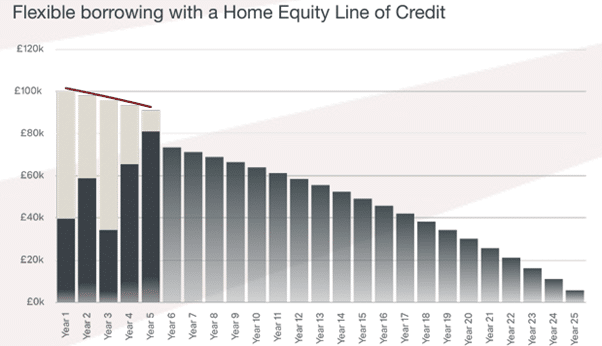
The HELOC products we offer typically have a 2, 3, 4 or five-year drawdown period.
During these five years, you can access funds from your agreed borrowing facility, subject to the lender’s conditions. You don’t necessarily have to withdraw the entire amount.
For example, you might be approved for a £100,000 HELOC but initially withdraw only £40,000. You could then access further funds as expenses arise.
The following example shows how a homeowner might draw and repay money during the initial five-year period.
| Year | Transaction | Outstanding balance |
|---|---|---|
| 1 | Withdraw £40,000 | £40,000 |
| 2 | Withdraw another £20,000 | £60,000 |
| 3 | Repay £25,000 of capital | £35,000 |
| 4 | Withdraw another £40,000 | £75,000 |
| 5 | Withdraw another £15,000 | £90,000 |
At the end of year five, the homeowner has an outstanding balance of £90,000. They haven’t used the full £100,000 facility, and the remaining £10,000 would no longer be available for withdrawal once the drawdown period ends. This example excludes interest, fees and other charges. It also assumes the lender permits the withdrawals and capital repayment shown.
Yes funds can be drawn during the initial five-year period, subject to the agreed facility limit.
However, it’s important to confirm whether capital repayments restore the amount available to withdraw and whether any minimum withdrawal amounts or other conditions apply. Our advisers can explain the lender’s specific drawdown and reborrowing rules.
Once the drawdown period ends, you can no longer make additional withdrawals under that facility.
The outstanding balance then moves into the repayment phase for the remainder of the agreed loan term.
For example, suppose you agree a 25-year HELOC term:
| Loan stage | Duration |
|---|---|
| Drawdown period | First 5 years |
| Remaining repayment period | Following 20 years |
| Total agreed loan term | 25 years |
If you have £90,000 outstanding at the end of year five, that balance would be repaid over the remaining 20 years under the lender’s repayment arrangements.
Your monthly payments may increase when the drawdown period ends, particularly if you were previously paying interest only.
This is an important consideration when deciding whether a HELOC is affordable.
During the drawdown period, you pay interest on the amount you’ve drawn rather than the entire facility.
For example, if you have a £100,000 facility but have only withdrawn £20,000, the interest calculation would generally be based on the £20,000 outstanding balance.
This can reduce interest costs compared with borrowing the full £100,000 immediately when you don’t need all the money.
However, any applicable fees, rate changes and repayment conditions must also be considered.
Only paying interest on drawn funds doesn’t mean the HELOC is automatically cheaper overall.
The total cost depends on how much you borrow, when you withdraw it, the interest rate, fees and how quickly you repay the balance.
Yes. The HELOC arrangement described in the original product information allows borrowers to make capital repayments during the drawdown period.
This can help reduce the outstanding balance and the interest charged.
For example, if you have withdrawn £50,000 and repay £10,000 of capital, your outstanding borrowing would reduce to £40,000 before accounting for any further transactions or charges.
This may be particularly useful if you receive a bonus, have fluctuating income or want to reduce the balance before the drawdown period ends.
The lender will need to confirm whether repayment limits, early repayment charges or other conditions apply.
A HELOC can be suitable for expenses that arise gradually rather than requiring a single upfront payment.
Common examples include home improvements and education costs.
Some lenders may also consider other borrowing purposes, including certain business-related expenditure, subject to their criteria and the applicable lending arrangements.
A HELOC may be useful if you’re renovating your home in stages. For example, you could withdraw funds for:
Architectural plans and initial building work
An extension
Kitchen and bathroom renovations
Landscaping
Additional work identified during the project
Rather than borrowing the entire renovation budget immediately, you can access funds as contractors and suppliers need to be paid.
This may help you manage cash flow and avoid paying interest on money you haven’t yet withdrawn.
However, it’s important to allow for unexpected costs and understand the conditions attached to further withdrawals.
Education costs often arise at regular intervals, such as the start of each school term.
A HELOC may allow eligible homeowners to withdraw funds as fees become due rather than borrowing several years’ worth of fees upfront.
For example, you could use the facility to pay school fees each term, provided sufficient funds remain available.
However, using borrowing secured against your home to meet recurring expenses requires careful consideration.
You would still need to repay the money, plus interest, and the facility would eventually enter its repayment phase.
Some HELOC lenders may consider borrowing for eligible business purposes. For example, a business owner might want access to funds for expenditure that arises at different stages of a project.
However, business-purpose borrowing may be subject to additional lender restrictions and different regulatory considerations.
Our advisers can check whether the intended purpose is acceptable before you apply.
Getting a quote won’t affect your credit score
A HELOC can offer several advantages over conventional lump-sum borrowing, depending on how you intend to use the money.
You can withdraw money when needed during the drawdown period instead of receiving the full facility upfront.
This may be useful for projects with uncertain or staged costs.
During the drawdown period, interest is generally charged on the outstanding amount you’ve withdrawn rather than the entire agreed facility.
This can be beneficial if you don’t need all the money immediately.
Making capital repayments during the drawdown period can reduce the amount outstanding and potentially lower future interest costs.
A HELOC can help fund planned expenses that arise over months or years rather than on one particular date.
However, these benefits need to be weighed against the interest rate, fees and the risks of borrowing against your property.
A HELOC isn’t suitable for everyone.
Before applying, it’s important to consider the following.
When the drawdown period ends, the remaining balance moves into the repayment phase.
If you’ve mainly been paying interest during the first five years, your subsequent repayments may be significantly higher because you’ll also need to repay the capital.
Having access to an agreed facility can make it easier to withdraw additional funds.
Every withdrawal increases your outstanding borrowing and may increase the total interest you pay.
The total cost depends on the product’s interest-rate arrangement, fees and repayment terms. If the interest rate is variable, your repayments could rise if the rate increases.
A HELOC is secured against your property.
If you cannot maintain the required repayments, the lender may ultimately take action to repossess your home.
It’s important to assess affordability both during the drawdown period and after it ends.
Eligibility depends on the lender’s criteria and your individual circumstances.
The main factors include property ownership, available equity, credit history and affordability.
Yes. A HELOC is secured against property, so you must have an acceptable ownership interest in the home being used as security.
The lender will also need to assess any existing mortgage or other secured borrowing.
You need sufficient equity to support the proposed facility within the lender’s loan-to-value limits.
For example, a homeowner with a property worth £400,000 and an existing mortgage of £350,000 has £50,000 of equity.
However, the existing mortgage already represents 87.5% of the property’s value.
That would exceed an 85% combined LTV limit before any additional HELOC borrowing is considered.
Having equity doesn’t automatically mean you meet the lender’s LTV requirements.
Potentially, although your options may be more limited.
Lenders assess your credit history to understand how you’ve managed previous borrowing.
Missed payments, defaults or other adverse credit events may affect eligibility, the available facility or the interest rate offered.
A less-than-perfect credit history doesn’t necessarily rule out every specialist lending option.
Our advisers can check whether your circumstances meet the criteria of lenders offering HELOC products.
The lender will consider whether you can afford the repayments, taking account of factors such as:
Employment or self-employed income
Household expenditure
Existing mortgage payments
Other credit commitments
Credit history
The proposed HELOC facility and repayment terms
Importantly, affordability may need to be assessed against the potential borrowing available under the facility, not simply the amount you intend to withdraw initially.
The lender will also need to consider whether the repayments remain manageable when the drawdown period ends.
Neither option is automatically better.
A HELOC may be more suitable where you need access to funds at different times and want flexibility over withdrawals.
A conventional secured loan may be more suitable where you know exactly how much you need and want to receive the full amount immediately.
For example, if you’re consolidating existing debts, a lump-sum secured loan may be easier to structure around the amounts being repaid.
If you’re undertaking a two-year renovation with costs arising in stages, a HELOC may offer useful flexibility.
The right choice depends on your borrowing purpose, affordability and the total cost of each option.
Our advisers can help you compare the available arrangements before deciding which may be appropriate.
At Willows Finance, we can help you explore specialist HELOC options and understand the application process.
The process generally involves four stages:
Tell us about your requirements. Let us know how much you may need, your property value and what you plan to use the funds for.
Check your eligibility. We’ll review the relevant lender criteria, including equity, affordability and credit history.
Review the proposed facility. We’ll explain the available borrowing limit, drawdown period, interest arrangements, fees and repayment terms.
Complete the application. If you decide to proceed, the lender will assess the application and complete the necessary property and legal checks before releasing access to the facility.
The lender’s final decision will depend on its full assessment.
We’re extremely proud to be rated ‘Excellent’ for our service standards. We’ve helped thousands of customers across the UK over the last 15 years to find the right finance for their needs – no matter how complicated the circumstances. And we look forward to helping you.
If you want to release equity from your home but don’t need all the money immediately, a Home Equity Line of Credit may be worth considering.
Our specialist advisers can help you explore HELOC products offering:
A five-year drawdown period
Facilities of up to £250,000
Combined borrowing of up to 85% LTV
Interest charged on funds drawn during the initial period, subject to product terms
The ability to access money in stages
Want to find out whether a HELOC could work for you?
Request a free, no-obligation quote or call 01656 766 158 to speak with the Willows Finance team.
Getting an initial quote won’t affect your credit score.
Your home may be repossessed if you do not keep up repayments on a loan secured against it.
If you have a question – we’d be happy to talk to you – simply call us…
(Mon-Fri 9am-8pm, Sat 10am-1pm)
Our Rating
At Willows Finance we ensure your personal information is kept secure and confidential.
PRIVACY OF YOUR INFORMATION
At Willows Finance Ltd, we appreciate that your privacy is extremely important to you. With this in mind, we have put in place a number of measures to ensure that any personal details we obtain from you as a result of visiting this website is processed and maintained in accordance with accepted principles of good information handling and also in accordance with the Data Protection Act 1988.
This statement provides you with details of the type of information we may hold about you, how we obtain and use information and how we protect your privacy.
Willows Finance Limited
Brocastle, Bridgend, CF35 5AS
Authorised and regulated by the Financial Conduct Authority
Firm Reference Number: 670052
Company Number: 06678545 (Registered in England and Wales)
This document explains the services we provide, the range of lenders and products we consider, how mortgage advice may be provided, and how Willows Finance may be paid. Please read it carefully before proceeding with an application.
If you need clarification about any part of this document, please contact us on 01656 766158.
Willows Finance arranges first and second charge mortgage products. Depending on the circumstances of the application, these may include:
We also arrange both regulated and unregulated bridging finance.
Not every product will be suitable or available to every customer. The products considered will depend on your circumstances, borrowing requirements, purpose of the borrowing, property, intended use of the property and the relevant lender criteria.
Depending on your circumstances, Willows Finance may:
If you are looking to increase borrowing secured on a property which already has a regulated mortgage, there may be different ways of raising the additional funds. Depending on your circumstances, these may include:
Where applicable, we will make you aware of these alternatives before proceeding. The options we are able to assess or advise on will depend on the service being provided and the lenders available to us.
The regulatory status of a mortgage or bridging loan depends on the circumstances of the transaction, including the property, how it is or will be occupied, the purpose of the borrowing and the customer’s circumstances.
Our business includes:
We will identify the regulatory status applicable to your application and explain the service and protections that apply. The protections available to you can differ depending on the type of mortgage or loan.
The range of lenders and products we consider depends on the type of finance you require.
We offer a comprehensive range of second charge mortgages from across the relevant market using a representative panel of lenders. We review our panel regularly to ensure that it remains sufficiently broad and representative. We do not consider products that are only available by applying directly to a lender.
We only offer first charge mortgages from a limited panel of 13 lenders. We consider the first charge mortgage products made available to us by Kensington Mortgages, The Mortgage Works, Aldermore, United Trust Bank (UTB), Together, Masthaven, West One, Norton, Bluestone, Vida, Pepper Money, Mansfield Building Society and Nationwide Building Society.
We do not offer every first charge mortgage available from across the market.
We consider products from a range of lenders available to Willows Finance for the relevant transaction.
Consumer Buy-to-Let and unregulated Buy-to-Let applications are considered within the relevant first charge, second charge or bridging route, depending on the structure of the transaction.
We do not provide a whole-of-market service and do not claim to consider every mortgage or secured finance product available in the UK. Our assessment is based on the lenders and products available through our lender and distribution arrangements.
Where the applicable regulatory rules require us to identify the lenders whose products we offer, the relevant lender list will be provided to you in a durable medium as part of the initial disclosure for your application. A lender list is also available on request where applicable.
The service provided will depend on the lender, product and application route identified for your circumstances.
Where Willows Finance provides the mortgage advice, we provide an advised mortgage broking service. We will obtain information about your needs and circumstances, assess the lending options available within the scope of our service and, where appropriate, make a mortgage recommendation.
We will make it clear where Willows Finance provides the mortgage advice and recommendation.
We may also provide a packaging service. This is a non-advised administrative service under which we may collect information and supporting documents, complete administrative checks, liaise with the relevant parties and submit or progress an application.
When we provide a packaging service, we do not assess the suitability of the mortgage, provide mortgage advice or make a personal recommendation. Any regulated mortgage advice or recommendation will be provided by the appropriately authorised intermediary responsible for advising you.
Our packaging service is not a regulated advisory service. However, the mortgage itself and any arranging activity connected with it may still be regulated and subject to the applicable regulatory requirements. We will explain the nature and regulatory status of the service we are providing before you proceed.
For some applications, particularly certain second charge mortgage applications, our sourcing exercise may identify a route where the subsequent mortgage advice is provided by another regulated mortgage intermediary.
In these cases, the Willows Finance service may include:
After the introduction, the receiving intermediary may take over the detailed application, advice and recommendation process. We will make it clear where this type of referral arrangement applies.
Where our sourcing process identifies Evolution Money Limited as an appropriate route and we introduce your application to Evolution Money, Willows Finance will not provide the regulated mortgage advice or make the final mortgage recommendation in relation to the Evolution mortgage.
Following the introduction, Evolution Money Limited will take over the detailed application and advisory process. Evolution Money will assess your needs and circumstances and will be responsible for any regulated mortgage advice and recommendation it provides in relation to the Evolution mortgage.
Willows Finance remains responsible for the service it provides before and in connection with the referral, including its initial assessment, sourcing and introduction activity.
If you are experiencing financial difficulty, or if you are considering borrowing to consolidate existing debts, free and impartial debt advice is available from MoneyHelper and other free debt-advice organisation.
MoneyHelper: www.moneyhelper.org.uk
You should consider obtaining free debt advice if you are unsure whether further borrowing or debt consolidation is right for you.
We process your personal information in accordance with our Privacy Policy. Where we introduce you to a lender or another intermediary, that organisation will process your information in accordance with its own privacy information.
Willows Finance Privacy Policy: willowsfinance.co.uk/privacy-cookie-policy/
The way Willows Finance is paid depends on the lender, product and application route. We may receive a fee paid by you, commission paid by a lender or another third party, or a combination of these. We will explain the basis on which we will be remunerated in connection with your application.
Where Willows Finance off an advised service our fees are split into two parts. A fee for the advice you receive and a fee for the processing of the application to completion. Both of these fees can be added to the loan rather than paid upfront or you have the option of paying them in advance. We do not arrange loans below £10,000.
For the advice the fee is as follows;
For a first charge mortgage, our advice fee is 5% of the amount borrowed, subject to a minimum fee of £625 and a maximum fee of £1,250.
For a second charge mortgage, our advice fee is 5% of the amount borrowed, subject to a minimum fee of £625 and a maximum fee of £1,750.
For a first charge mortgage, our processing fee is 5% of the amount borrowed, subject to a minimum fee of £625 and a maximum fee of £1,250.
For a second charge mortgage, our processing fee is 5% of the amount borrowed, subject to a minimum fee of £625 and a maximum fee of £1,750.
| Service | First charge | Second charge |
|---|---|---|
| Advice fee | 5%, min £625, max £1,250 | 5%, min £625, max £1,750 |
| Processing fee | 5%, min £625, max £1,250 | 5%, min £625, max £1,750 |
On borrowing of £10,000 5% would be £500, but the minimum fee for advice and processing means that we would charge £625 for each to £1250 in total.
On borrowing £20,000 the total fees would be £2,000
On borrowing £50,000 the maximum fee means that we would charge a total of £2500 for a 1st charge mortgage and £3500 for a 2nd charge mortgage.
If your mortgage or loan completes following an introduction made by Willows Finance, we will receive commission from the lender or another third party in the distribution chain unless we tell you otherwise. Different lenders may pay different amounts and may use different commission models.
Commission models may include:
The availability or amount of commission does not determine which lender we consider appropriate for your circumstances. Where applicable, we will tell you that commission will be received.
For an MCD regulated mortgage (a mortgage within the Mortgage Credit Directive rules), where the exact amount of commission is not known at the time of the initial disclosure, we will tell you that the actual amount will be disclosed later in the ESIS. Where applicable and on request, we will also provide information about how commission levels vary between lenders offering the mortgage being considered.
Where we introduce you to Evolution Money, the commercial arrangement is different from a broker fee charged directly by Willows Finance.
Under the current Evolution arrangement, Evolution Lending charges a Product Fee equal to 10% of the net loan advance, subject to a maximum of £5,000. If the mortgage completes, Evolution pays the corresponding amount to Willows Finance as commission/remuneration for the sourcing, distribution and introduction service.
The amount of the product fee and the amount of remuneration payable to Willows Finance will be disclosed to you in the relevant mortgage documentation before completion.
Example: on a £10,000 net advance, a 10% Product Fee would be £1,000. The actual Product Fee and the amount of commission payable to Willows Finance will be set out in the relevant Evolution mortgage documentation before completion.
If you choose to add a Product Fee or other fee to your mortgage, interest will be charged on that amount while it remains outstanding, increasing the total amount you repay.
Where a Willows Finance fee is payable only on completion, it will not become payable if the mortgage does not complete. Any fee payable before completion, third-party costs and the circumstances in which a fee is refundable or non-refundable will be explained where applicable.
Fees which have become payable following completion are generally non-refundable unless the relevant contractual terms, applicable law or regulatory redress require otherwise.
Before you become bound by a regulated mortgage, you will receive the relevant mortgage illustration or European Standardised Information Sheet (ESIS) and the lender’s offer documentation as applicable.
These documents contain important information about the proposed mortgage, which may include:
Please read these documents carefully. If anything is unclear or does not reflect your understanding, contact the firm responsible for the advice or recommendation before proceeding.
You may tell us that you no longer wish to proceed with an application before completion. Whether any third-party cost is payable or refundable will depend on its own terms.
For an MCD regulated mortgage (a mortgage within the Mortgage Credit Directive rules), the lender will provide a binding offer with a reflection period of at least seven days. You may normally accept the offer during that reflection period if you decide to proceed.
Once a mortgage has completed, there is generally no right simply to cancel or withdraw from the mortgage. You may have a right to repay the mortgage early in accordance with its terms, and an early repayment charge may apply.
Always check the early repayment section of the ESIS and mortgage offer before completion if early repayment or regular overpayments are important to you.
If you miss or make late payments, the lender may apply charges, and your credit record may be affected. Continued failure to maintain payments may result in enforcement action and ultimately repossession of the property used as security.
If you are experiencing financial difficulty, contact your lender as soon as possible and consider obtaining free independent debt advice.
Consolidating existing debts into a mortgage can reduce monthly payments but may increase the total amount of interest you pay if the borrowing is repaid over a longer period.
Debts which are currently unsecured may become secured against your home. Extending the repayment period may mean that you pay considerably more overall even where the monthly payment is lower.
Interest rates on variable-rate mortgages can increase, which may increase monthly repayments and the total amount repaid.
YOUR HOME MAY BE REPOSSESSED IF YOU DO NOT KEEP UP REPAYMENTS ON A MORTGAGE OR OTHER LOAN SECURED ON IT.
If you are dissatisfied with any aspect of the service provided by Willows Finance, please contact us:
Willows Finance Limited
Brocastle, Bridgend, CF35 5AS
Telephone: 01656 766158
Email: [email protected]
We will investigate your complaint in accordance with our complaints procedure. If you remain dissatisfied with our final response, or in other circumstances where you are eligible to do so, you may be able to refer your complaint to the Financial Ombudsman Service.
Financial Ombudsman Service: www.financial-ombudsman.org.uk
Where another regulated intermediary has provided the mortgage advice or recommendation, complaints about that firm’s advice should normally also be raised with that firm. You can still complain to Willows Finance about the service provided by Willows Finance.
The Financial Ombudsman Service can generally consider complaints about regulated or otherwise covered activities, including certain activities that are ancillary to them. It may not be able to consider a complaint that relates solely to an unregulated product or service and has no connection with a regulated or otherwise covered activity. Whether a complaint falls within its jurisdiction will be determined by the Financial Ombudsman Service based on the individual circumstances.
Willows Finance Limited is covered by the Financial Services Compensation Scheme for eligible regulated activities. If an authorised firm is unable to meet an eligible claim, compensation may be available from the FSCS.
For protected home finance mediation, the current compensation limit is 100% of an eligible claim up to £85,000 per eligible claimant, per firm. Eligibility depends on the circumstances of the claim and the applicable FSCS rules.
FSCS protection does not generally apply to a claim arising solely from an unregulated product or service, including any packaging service that falls outside regulated home-finance mediation. Whether a claim is eligible will depend on its individual circumstances and the applicable FSCS rules.
Further information: www.fscs.org.uk
Once we have received sufficient information about your circumstances and requirements, we will carry out the relevant initial assessment and sourcing process and explain which application route applies to you.
Where Willows Finance provides the mortgage advice, we will continue through our advised mortgage process and explain any recommendations made.
Where your application is referred to another regulated intermediary, such as Evolution Money, we will explain that the receiving intermediary will take over the subsequent application and advisory process where applicable.
Please review all mortgage illustrations, ESIS documents, fee and commission disclosures, offer documents and other terms carefully before deciding whether to proceed. If anything is unclear, ask before committing to the mortgage.
Let us know what you're looking for today